Akaroa Dolphin Tours From Christchurch: The Complete Guide
Updated November 2, 2026
Two operators run dolphin cruises on Akaroa Harbour, one runs the swim, and a handful of Christchurch companies package the drive. Here is what each costs and what each actually delivers.
Short answer
A two-hour dolphin harbour cruise costs from NZ$116 per person through the bookable listings, NZ$140 on the Akaroa Dolphins operator page, and swimming with Hector's dolphins runs NZ$250 direct with Black Cat, from NZ$385 as a full day tour from Christchurch. Swimming runs 1 October to 30 April only; cruises and sightings run year-round.
Akaroa is the place New Zealanders mean when they say you can swim with Hector's dolphins, and almost every dolphin tour sold from Christchurch ends up on the same harbour. Black Cat runs a two-hour nature cruise at NZ$130 per adult on its own site, with a child fare of NZ$60 for ages 5 to 15, and the swim at NZ$250 per adult inside a 1 October to 30 April season. Akaroa Dolphins runs a competing two-hour cruise at NZ$140 per adult, child NZ$70. The bookable listings on this site start at NZ$116 for the Black Cat cruise and NZ$385 for a full swim day tour from Christchurch with transport included.
That is the short version. The longer version is that "dolphin tour" covers three quite different products: a cruise where you watch from the deck, a swim where you stand in the water in a wetsuit while dolphins circle, and a nine-hour packaged day trip that bolts the harbour experience onto the 90-minute drive from Christchurch. Choosing wrong is expensive. This guide prices all three, names the operators behind each number, and answers the questions travellers keep asking about the dolphins themselves.
Which Akaroa Dolphin Tour Should You Book?
The cruise is the right default, the swim is the right splurge, and the packaged day tour is the right call only if you have no car. A cruise starts at NZ$116 per person bookable; the swim is NZ$250 direct or from NZ$385 with transport; full day tours from Christchurch run from NZ$290 to NZ$385 including lunch and the drive. If seeing dolphins matters more than being in the water with them, book the cruise.
The decision splits cleanly on three questions. Do you want to be in the water? Is October to April in your travel window? And are you driving yourself or not?
If you are driving, you can book any harbour product direct and build your own day; the drive is about 90 minutes each way on State Highway 75, and the drive versus tour bus question mostly comes down to whether the winding summit road appeals to your passengers. If you are not driving, a packaged tour is the only realistic way to do Akaroa in a day from Christchurch, and the premium over DIY covers the coach, the commentary and lunch on the better ones.
The swim deserves special honesty. It is weather-dependent, season-limited, and it is the most expensive way to see the same dolphins a cruise shows you from the deck. Travellers on Reddit keep debating exactly this trade-off, the swim versus cruise question, and the honest answer is that swimmers get proximity and cruisers get reliability and price. The full breakdown is in the swim versus cruise comparison guide.
What Does Every Akaroa Dolphin Option Cost?
Harbour cruises cost NZ$116 to NZ$140 per adult, the swim costs NZ$250 per adult direct with Black Cat, and packaged day tours from Christchurch run NZ$290 to NZ$385 per person with lunch included. Children pay NZ$60 with Black Cat and NZ$70 with Akaroa Dolphins, and under 5s travel free with Black Cat. Every figure below names its source.
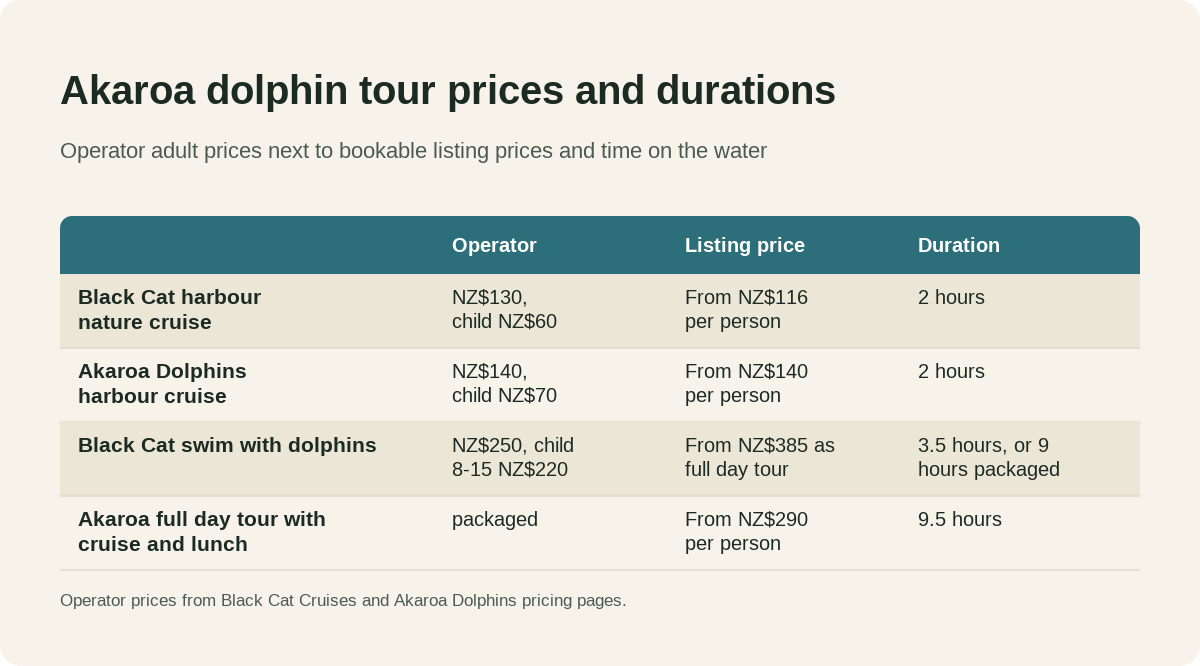
The table below separates the operator's own prices from the bookable listing prices, because they are not always the same number. Where the two differ, both are honest: the listing price is what the bookable product costs, the operator price is what the operator publishes on its own site.
| Product | Operator price (adult) | Bookable listing price | Duration | Rating |
|---|---|---|---|---|
| Black Cat harbour nature cruise | NZ$130, child NZ$60, under 5 free | From NZ$116 per person | 2 hours | 4.6 across 276 reviews |
| Akaroa Dolphins harbour cruise | NZ$140, child NZ$70, infant NZ$30 | From NZ$140 per person | 2 hours | 5.0 across 2,275 reviews |
| Black Cat swim with dolphins | NZ$250, child 8-15 NZ$220, spectator NZ$180 | From NZ$385 as full day tour | 3.5 hours, or 9 hours packaged | 3.8 across 37 reviews |
| Akaroa full day tour with cruise and lunch | packaged | From NZ$290 per person | 9.5 hours | 4.6 across 307 reviews |
Source for operator rows: Black Cat Cruises and Akaroa Dolphins pricing. The swim listing's 3.8 rating across 37 reviews is the weakest on the harbour, and that is worth reading correctly: it reflects weather cancellations and cold-water reality as much as the experience itself, a pattern the cancellation terms explain.
For budgeting a whole day rather than a ticket, the full Akaroa day trip cost breakdown adds fuel or fares, food and the cruise into one worked total.
When Can You Swim, And When Can You Cruise?
Swimming runs from 1 October to 30 April only, and the operator states wetsuit and mask are provided; cruises run year-round, and Hector's dolphins are present in the harbour in every month, according to both operators and the Department of Conservation. Winter visitors, meaning May to September, can cruise but cannot swim, full stop.
The seasonal window is a hard rule, not a guideline. It exists because sea temperature and dolphin behaviour change in winter, and no operator sells swim tickets outside it. If your trip falls in the winter half of the year, the cruise decision has been made for you, and the month-by-month dolphin guide shows what each month actually delivers on the water.
What you wear in the water matters more than most first-time swimmers expect, even with a provided 5mm wetsuit; the practical packing answer is covered in what to wear for the Akaroa dolphin swim.
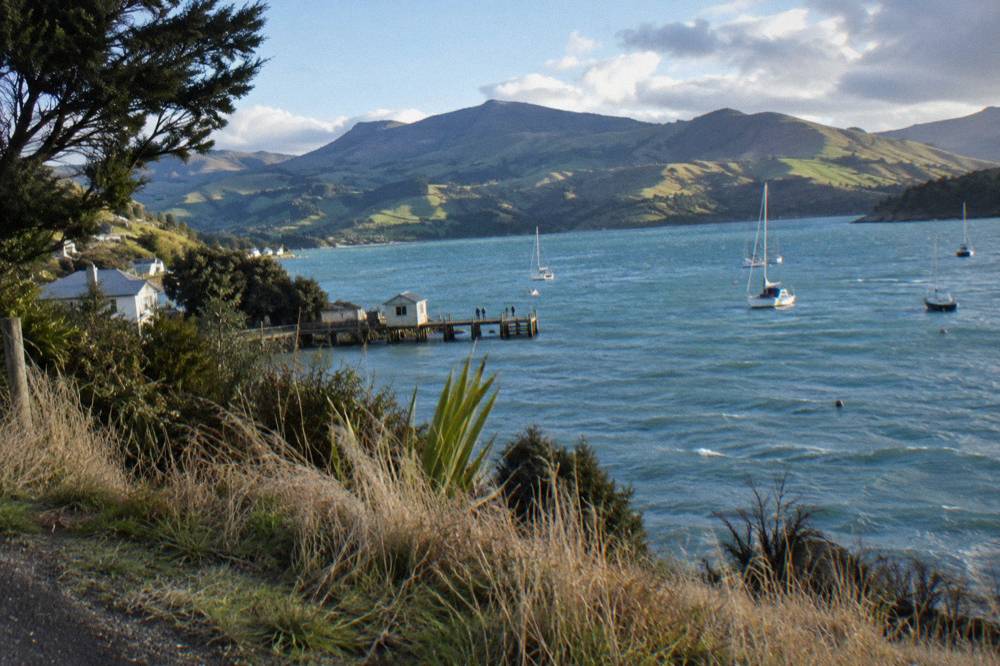
The sighting picture is the one part of the sales pitch that holds up. Black Cat reports dolphins on roughly 95 to 97 percent of nature cruises and offers a return voucher when a trip sees none, a figure quoted from a reseller page carrying the operator's claim. Akaroa Dolphins makes a similar year-round presence claim on its own site, and DOC's 2022 release on summer distribution shifts confirms the dolphins move around the harbour rather than leaving it. Nothing here is a guarantee, but the base rate is unusually high for a wildlife product.
Swim With Dolphins Or Take The Harbour Cruise?
The swim puts you in the water at NZ$250 direct for around 3.5 hours of boat and water time; the cruise keeps you on deck for 2 hours at NZ$130 direct. Swimmers get within metres of the dolphins by being in their element; cruisers see more of the harbour, more often, in any month, for about half the price. Rough sea days cancel the swim far more often than the cruise.
Both products target the same animals. Hector's dolphins are small, coastal and resident, which is why the sighting economics work for a two-hour cruise at all: the boats do not have to search far. The difference is entirely in what you do when the boat finds them.
The swim has three structural weaknesses the brochures underplay. It is season-bound. It is sea-state-bound, and Akaroa's sheltered inner harbour is not the whole operating area. And it is physically demanding in cold water even in summer, in a wetsuit, which is why the spectator fare exists at NZ$180 for family members who would rather watch from the boat.
The cruise's weakness is simpler: some people find two hours of harbour scenery with dolphin stops too gentle, especially teenagers. For most travellers the cruise is the better first Akaroa experience, with the swim as a deliberate splurge for confident swimmers travelling in season. The detailed head-to-head is in the swim versus cruise guide.
| Factor | Swim with dolphins | Harbour cruise |
|---|---|---|
| Season | 1 Oct to 30 Apr only | Year-round |
| Direct adult price | NZ$250 (Black Cat) | NZ$130 (Black Cat) or NZ$140 (Akaroa Dolphins) |
| Time on the water | 3.5 hours total | 2 hours |
| Minimum age | 8 to swim, spectators any age | Generally no minimum, under 5 free with Black Cat |
| Weather sensitivity | High, cancels in rough conditions | Moderate |
| Typical experience | In the water, dolphins may circle swimmers | On deck, dolphins approach the boat |
The swim's booking terms deserve a read before you pay. The full day tour version from Christchurch, which bundles transport and the swim, holds a 3.8 rating across 37 reviews, and the cancellation pattern is the reason: swimmers who get weathered out are usually rebooked rather than refunded, so travel insurance that covers activity cancellation earns its premium here.
Which Operator Should You Choose: Black Cat Or Akaroa Dolphins?
Both run about two-hour cruises on the same harbour with similar inclusions; Black Cat is cheaper at NZ$130 adult direct versus NZ$140, departs from 61 Beach Road, and reports a 95 to 97 percent sighting rate with a return voucher, while Akaroa Dolphins runs to NZ$140 with a 5.0 rating across 2,275 reviews on its bookable listing. There is no bad choice; there is a cheaper choice and a slightly better-reviewed one.
The two companies are genuinely close competitors. Departure patterns differ in detail: Black Cat's nature cruise sails at 10:45 am and 1:30 pm with an extra 3:45 pm sailing in peak summer, while Akaroa Dolphins lists departures including a 12:45 pm sailing that runs year-round. If your day tour or self-drive schedule only fits one departure time, that timetable detail, not the brand, makes the decision.
| Departure | Black Cat nature cruise | Akaroa Dolphins cruise |
|---|---|---|
| Morning | 10:45 am | 10:15 am |
| Midday | 1:30 pm | 12:45 pm, year-round |
| Afternoon | 3:45 pm, peak summer only | 3:15 pm |
| Check-in point | 61 Beach Road | Main wharf area |
Review pools are the other honest differentiator. The Akaroa Dolphins listing carries 5.0 across 2,275 reviews, one of the deepest pools of any tour on this site, and the Black Cat listing carries 4.6 across 276. Both are strong; neither is a warning sign. The swim product's 3.8 across 37 is the only rating here that should slow a booking down, and rebooking flexibility is the fix. The bookable Black Cat cruise page is here.
A cruise ticket is also the cheapest way to turn an Akaroa day into a structured one. The one-day Akaroa itinerary is built around fitting the cruise, lunch and the township walks into a single self-drive day, which is what most Christchurch visitors actually have.
Is The Full Day Tour From Christchurch Worth The Money?
The full day tour from NZ$290 per person includes the return coach, commentary through Banks Peninsula, a harbour cruise and lunch, against roughly NZ$130 for the cruise plus fuel or rental costs if you drive yourself; the swim day tour runs from NZ$385. Without a car, the day tour is not a convenience premium, it is the only way to make the trip happen.
The arithmetic depends on your transport. A rental car day costs what it costs, fuel for the roughly 160 to 170 km round trip is modest, and parking in Akaroa is manageable outside peak summer weekends. Add the NZ$130 cruise and a self-drive day lands well under the NZ$290 tour price, at the cost of doing all the driving on a winding road.
| Option | From (per person) | Includes | Drive yourself? |
|---|---|---|---|
| Self-drive plus direct cruise booking | NZ$116 to NZ$140 | Cruise only, lunch extra | Yes, about 90 min each way |
| Full day tour with cruise and lunch | NZ$290 | Coach, cruise, lunch, commentary | No |
| Swim with dolphins day tour | NZ$385 | Coach, swim, wetsuit and mask provided | No |
| Packaged day trips, general market | NZ$350 to NZ$600+ | Varies widely | Usually no |
The NZ$350 to NZ$600+ packaged range comes from a third-party price survey of Akaroa day trips, so treat it as market context rather than a firm quote; the two firm tour prices above it come from bookable listings on this site. The two bookable Akaroa products that matter for most readers are the full day tour with cruise and lunch and the swim day tour, both roughly 9.5 hours door to door.
What Is Akaroa Famous For?
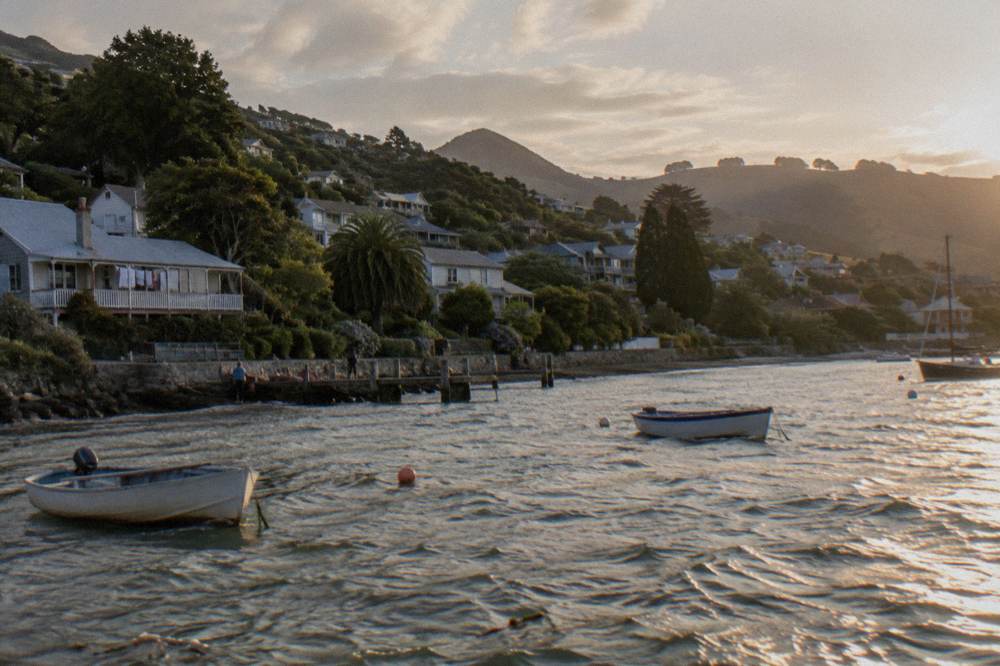
Akaroa is famous as the permitted place to swim with Hector's dolphins, as a former French settlement on Banks Peninsula whose street names and colonial architecture survive, and as a cruise-ship and day-trip destination about 90 minutes from Christchurch by road. The dolphins are the headline, but the town's French colonial history is why the town itself looks like nowhere else in New Zealand.
The history is real and specific: the town began as a French settler outpost, and its identity still shows it, from Rue Lavaud to the tricolour flags on the waterfront. That heritage, plus the deep harbour the volcanism of Banks Peninsula created, is what turns a two-hour cruise into a full day out. The harbour is a flooded volcanic crater, which is why the water is sheltered enough for dolphin swimming at all.
The practical fame, though, is the dolphin. Akaroa is the base for two cruise operators and one swim operator, and the town's whole visitor economy bends around them. The official Akaroa District Promotions site is the useful hub for the drive, the maps and the cruise-ship schedule, which matters because cruise-ship days visibly change the town's traffic and the tour boats' load.
Why Can't You Swim With Dolphins Anymore?
You can: swimming with Hector's dolphins in Akaroa runs every year from 1 October to 30 April under a Department of Conservation permit. What ended is unlimited and everywhere-else swimming; Hector's dolphins are a threatened species, Akaroa is one of the very few permitted swim locations, and the winter closure and permit system are the conservation controls, not a ban.
The confusion comes from three real changes stacking up in travellers' memories. First, the swim season is fixed at October to April, so winter enquiries get told no. Second, the operation is permit-bound and tightly controlled, with swimmers, wetsuits and group sizes managed by the operator's DOC conditions. Third, rules around marine mammal interaction have tightened everywhere in New Zealand over the years, and people who remember looser arrangements assume the Akaroa swim went with them. The operator's own page on year-round dolphin presence states the seasonal split plainly: dolphins in all months, swimming in the summer half.
The same question appears constantly in Google's related searches for Akaroa, usually from people who half-remember a news story. The short answer for your trip: if you are visiting between October and April, the swim exists and books out in peak summer; between May and September it does not, and the cruise is the product.
What Is The Best Time To See Dolphins?
Hector's dolphins are present in Akaroa Harbour year-round, so the best time is the window that fits your trip rather than a magic month; if you want to swim as well as see them, 1 October to 30 April is the only window, and the warmest water and most settled sea conditions sit in the December to February summer. Black Cat reports sightings on roughly 95 to 97 percent of cruises in all seasons.
Both operators and the Department of Conservation agree on the year-round presence; a DOC 2022 release noted summer distribution shifts within the region, meaning the dolphins move within and around the harbour rather than vanishing. The month-by-month detail, including what winter cruises actually look like, is in the best month for Hector's dolphins guide.
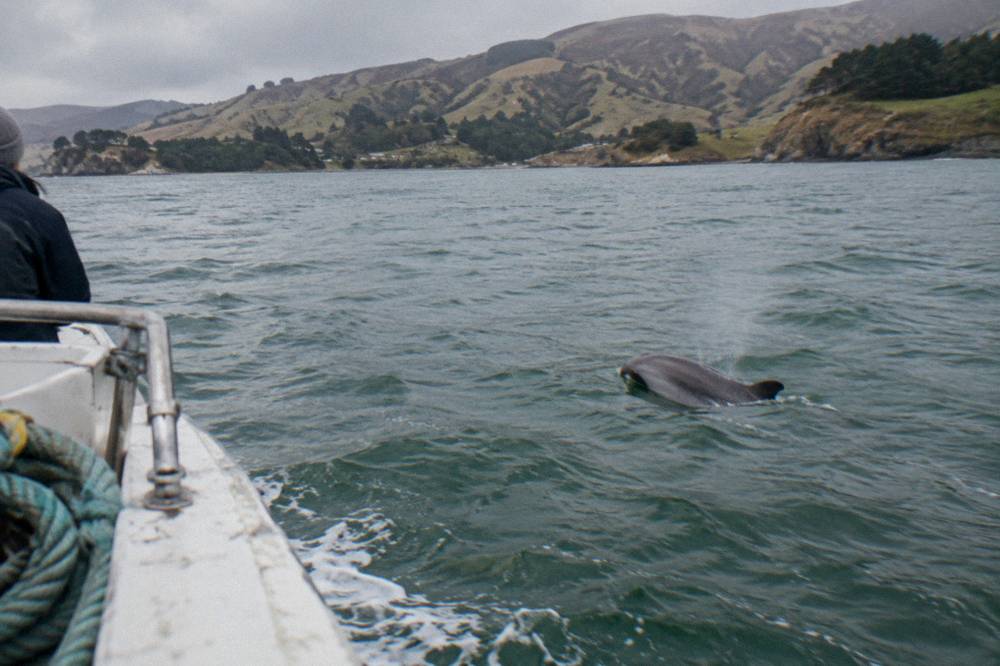
Timing within the day matters less than timing around weather. The Reddit threads on Akaroa keep repeating one piece of practical advice: book the cruise near your travel date rather than weeks ahead where possible, so you can pick the calmer day, and morning departures give you a rebooking window the 3:45 pm summer sailing does not. That is traveller consensus, not an operator rule, and it is sound.
What Are Some Famous Dolphins In New Zealand?
Hector's dolphin is New Zealand's famous endemic dolphin and one of the world's smallest, found only around the South Island's coasts, with Akaroa Harbour as the accessible place to see it; the Maui dolphin, its North Island relative, is the famous endangered one, and Kaikoura's dusky dolphins and the resident sperm whales are the other headline marine mammals on the tourist trail.
Hector's dolphins are the whole reason the Akaroa swim industry exists: small, coastal, grey with the distinctive rounded dorsal fin, and resident rather than migratory. Their North Island relatives, the Maui dolphin, are the ones that make conservation news, because the population is critically small and no swim tourism touches them.
Kaikoura, two and a half hours north of Christchurch, is the other pole of Canterbury's marine tourism: dusky dolphins in large pods, a swim product of its own at NZ$295 in the November to April peak, and sperm whales resident year-round with a sighting success the operator states as over 90 percent. The two towns are not substitutes, they are a pair, and many travellers do both in one South Island trip. For the whale side, the Kaikoura whale watching from Christchurch guide covers it in the same depth as this page covers the dolphins.
How Do You Actually Get To Akaroa From Christchurch?
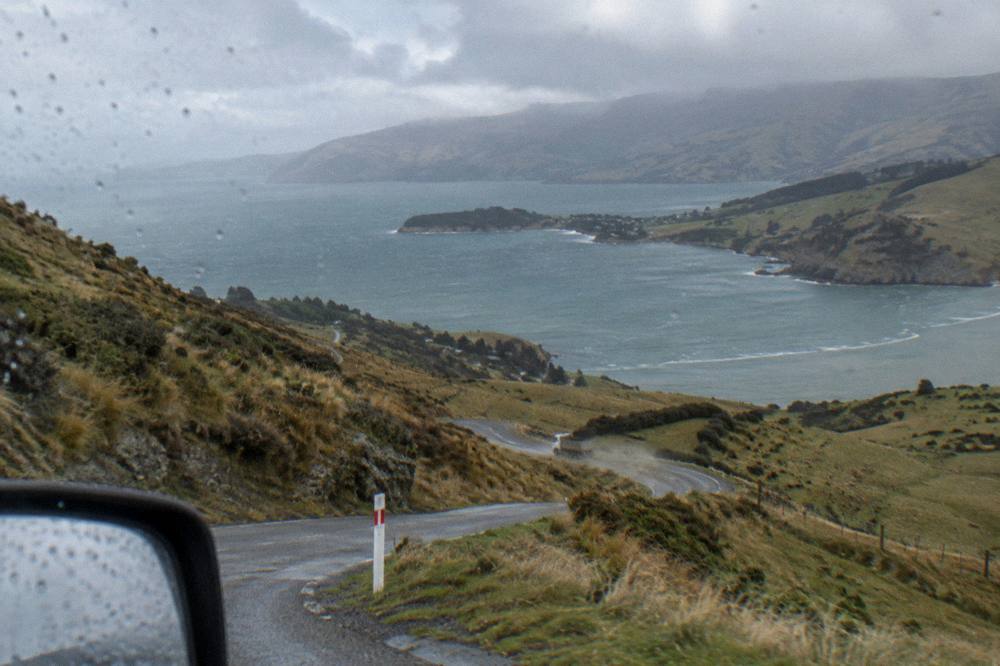
The drive is about 90 minutes each way on State Highway 75, roughly 80 to 85 km, over the Port Hills and along the summit ridge of Banks Peninsula; there is no train, and tour coaches from Christchurch take about the same time with commentary, which is why every packaged dolphin day tour runs roughly 9 to 9.5 hours door to door.
The road is the part of the plan first-time visitors underestimate. It is sealed and well maintained the whole way, but it climbs, curves and narrows after Little River, and some passengers genuinely do not enjoy the summit section. If that describes anyone in your car, the coach tour is not the lazy option, it is the considerate one. The trade-offs are laid out honestly in the drive or tour bus comparison.
| Way to Akaroa | Time each way | Cost indicator | Notes |
|---|---|---|---|
| Self-drive via SH75 | About 90 min | Fuel plus rental day | Winding summit section after Little River |
| Packaged day tour coach | About 90 min | Included in tour price | Commentary, roughly 9.5 h door to door |
| Cruise-ship shore day | Varies | Ship excursion pricing | Akaroa is a tender port |
Once you are in the township, everything dolphin-related happens on or near the waterfront. Black Cat checks in at 61 Beach Road, and the Akaroa Dolphins departures leave from the main wharf area; both are within a short walk of the township's cafes, which is why a cruise ticket plus a long lunch is the classic Akaroa day.
Planning Checklist: Booking, Weather And What To Bring
Book the swim well ahead inside the October to April season, keep the cruise flexible so you can chase the calmer day, bring warm layers for the boat in any month, and read the cancellation terms before paying: swimmers are typically rebooked rather than refunded when the sea state turns, and the Black Cat sighting voucher covers missed dolphins, not bad weather.
The details land in four buckets.
Booking: the swim sells out in peak summer, the cruise rarely does; if you want a specific departure time in cruise-ship season, book ahead.
Weather: sea state cancels the swim first and the cruise second; morning bookings leave rebooking room the same day.
Clothing: the harbour is cooler than Christchurch, and boat wind chill is real even in January; swimmers are provided a 5mm wetsuit and mask, and spectators need the same warm layers as cruisers.
Insurance: the gap between a rebooking and a refund is where travel insurance that covers cancelled paid activities earns its cost on a swim booking.
For readers planning a wider South Island trip, Christchurch Tours covers the Kaikoura, TranzAlpine and Mount Cook day trips with the same operator-by-operator pricing treatment as this guide.
Common Questions About Akaroa Dolphin Tours
What is Akaroa famous for?
Akaroa is famous as the place you can swim with Hector's dolphins, for its French colonial history as an early French settler town, and for sitting inside a flooded volcanic crater on Banks Peninsula about 90 minutes from Christchurch.
What is the best time to see dolphins?
Hector's dolphins live in Akaroa Harbour year-round, so any month delivers sightings on the cruises, which Black Cat reports at roughly 95 to 97 percent of trips. To swim rather than watch, your only window is 1 October to 30 April.
Why can't you swim with dolphins anymore?
You can. The swim runs every year from 1 October to 30 April under a Department of Conservation permit; what no longer exists is loose, unregulated swimming, and the winter closure plus permit controls are conservation measures protecting a threatened species, not a ban.
What are some famous dolphins in New Zealand?
The Hector's dolphin, one of the world's smallest dolphins, found only around the South Island and seen reliably in Akaroa; the Maui dolphin, its critically endangered North Island relative; and Kaikoura's dusky dolphins, which swim in large pods.
How much does a dolphin cruise in Akaroa cost?
From NZ$116 per person through the bookable Black Cat listing, NZ$130 per adult direct with Black Cat, or NZ$140 per adult with Akaroa Dolphins; children pay NZ$60 with Black Cat and NZ$70 with Akaroa Dolphins, and under 5s travel free with Black Cat.
Is the dolphin swim worth it compared to the cruise?
The swim at NZ$250 direct puts you in the water for about 3.5 hours in the October to April season; the cruise at NZ$116 to NZ$140 keeps you on deck for 2 hours in any month. Swimmers buy proximity, cruisers buy reliability and price, and rough-sea days cancel the swim far more often than the cruise.